The short answer
For SUV road travel, our first comparison would be a correctly sized GUNNER G1 with documented crash-test evidence for that exact size and setup. It is a starting point, not a universal winner: the best kennel must also suit your dog and fit through your hatch with room for the specified installation. If the complete setup cannot fit, choose another suitable restraint or change the seating plan instead of squeezing the dog into a smaller kennel.
RuffLand is worth comparing when door placement is the difficult part of your layout. Petmate Sky Kennel and SportPet’s rigid travel kennel are conventional travel-container options to investigate, but their travel or airline descriptions do not establish crash protection. Below, we separate those jobs so you can make a useful shortlist.
This guide compares published information; we have not performed hands-on SUV fit or crash tests. We may earn a commission from purchases through links. How our research and affiliate links work.
Compare the options by the job they need to do
| Option | Why compare it? | What decides the purchase? |
|---|---|---|
| GUNNER G1 | Road-travel shortlist where independent crash evidence is a priority. | Exact certified size, dog fit, full exterior footprint and required installation. |
| RuffLand | Layouts where a different door arrangement may improve access. | Generation, door position, usable interior and installation documentation. |
| Petmate Sky Kennel | A rigid travel container to compare across car and airline needs. | Exact size and trip requirements; airline wording is not a crash rating. |
| SportPet rigid travel kennel | A portable container with a different footprint and handling features. | Selected version, assembly, wheel instructions and intended vehicle use. |
GUNNER G1: where we would start for road-travel evidence
The Center for Pet Safety directory lists G1 Small, Medium and Intermediate kennels. Certification applies to the listed product and configuration; do not extend it to every G1 size or assume that any strap arrangement is equivalent. Check the current CPS certification directory and the maker’s instructions before buying.
Work out the complete installed footprint and whether you can lift and load the kennel comfortably. A suitable interior is only half the decision if the shell, door swing or attachment points conflict with your SUV.
Compare GUNNER kennel sizes and buying options →
RuffLand: compare when access is the sticking point
A rear-facing kennel door may be convenient for hatch loading, while a different door arrangement may be useful in a more complicated layout. Compare the exact single- or double-door model rather than treating the brand as one shape. Make sure your dog can enter and exit without climbing over luggage.
Door flexibility does not establish a crash rating. Evaluate the evidence and installation instructions for the product you would actually order.
Explore RuffLand models and door layouts →
Petmate Sky Kennel: compare a conventional rigid travel container
The Sky Kennel is worth investigating if you need a rigid container and are also planning air travel. The 36-inch and 48-inch listings below are different sizes, not interchangeable recommendations. The larger shell can create a very different loading problem even in a large SUV. Confirm usable interior measurements and the exact transport instructions; a dog-weight range alone does not choose the size.
Check the Petmate Sky Kennel, 36-inch on Amazon ↗
See the listing’s recorded specifications and photo →
Check the Petmate Sky Kennel, 48-inch on Amazon ↗
See the listing’s recorded specifications and photo →
These are shopping candidates, not our crash-certified picks. Verify your airline’s own requirements separately if you plan to fly. Read Petmate’s Sky Kennel information.
SportPet: compare the selected rigid model and its handling features
The linked listing is the Large 31.5-inch rigid travel kennel in Dark Gray, with removable wheels and a collapsible design. It is not one of the brand’s soft pop-open carriers. Check how it assembles, whether the wheels must be removed for the intended use, and what the manufacturer permits for installation in a moving vehicle.
Check the SportPet Large rigid travel kennel on Amazon ↗
See the listing’s recorded specifications and photo →
Do not infer crash protection from the shell material or airline-compliant wording. Check the seller, selected configuration, current price and return terms for every listing before ordering.
How to measure an SUV for a dog kennel
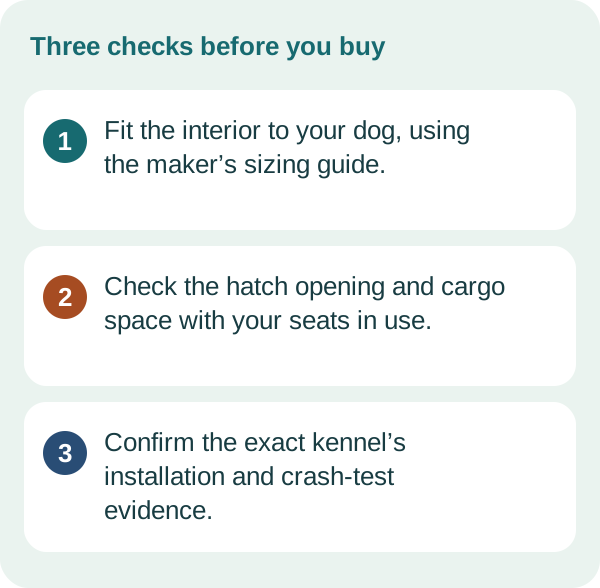
- Measure your dog first. Follow the kennel maker’s sizing method and compare usable interior space. Your dog needs the posture and movement the maker specifies; bedding must not consume necessary headroom.
- Put the seats where they will be on the trip. Record which rows are occupied and where child seats or other fixed equipment must stay. Cargo volume with all seats folded does not describe your usable kennel space.
- Measure the floor footprint. Check usable length and the narrowest width, including wheel arches and trim. Leave room for the installation specified by the kennel maker.
- Measure height where the kennel’s corners will sit. Sloping rear glass, a cargo cover and seatbacks can reduce space above an otherwise generous floor.
- Check the loading opening. The complete shell, handles and latches must pass through the hatch. Do not assume it can be tilted into place or assembled inside unless the instructions permit your plan.
- Test access and clearance. Use a full-size cardboard mock-up, open the kennel door, and close the hatch gently by hand. A mock-up checks shape; it cannot verify restraint strength or crash performance.
Choose for the SUV layout you actually use
Compact crossover: prioritize the hatch opening, sloping glass and wheel-arch width. A kennel that uses almost the entire cargo floor may leave no practical space for the door or travel bags. Start with our Subaru Forester, Mazda CX-50 or Nissan Rogue guide if that is your vehicle.
Three-row SUV: measure behind the row that stays occupied. A setup that works with the third row folded may be unusable on a family trip. Compare our Toyota Highlander, Volvo XC90 and Mazda CX-90 guides.
Full-size SUV: more floor space still requires an opening check, manageable lifting and a complete restraint plan. Our Chevrolet Tahoe and Ford Expedition guides help you think through occupied seats and cargo access.
Two dogs: plan each dog’s interior and each kennel’s installation separately, then measure both shells together. Include both door swings and access to all required attachment points. Do not assume a product labeled “SUV crate” proves compatibility with your model.
Installation, ventilation and everyday use
Read both the vehicle manual and the kennel instructions before purchase. Confirm the permitted location, required hardware, anchor requirements and orientation. A cargo hook is not automatically a suitable restraint anchor. If the instructions do not establish a workable installation, ask the manufacturer for guidance before treating the setup as ready for road travel.
Keep ventilation openings clear and prevent bags from shifting into the kennel or blocking its door. Check the cargo area’s airflow with the car configured for the trip. Plan water and rest breaks, and never use a kennel as a reason to leave a dog unattended in a parked vehicle.
Introduce the kennel while parked, then build up to short journeys once your dog is comfortable. Check latches, attachment hardware and the shell for damage before travel. Follow the maker’s cleaning instructions, dry the kennel thoroughly and reassess fit as a puppy grows or your dog’s mobility changes.
What about wire and soft-sided crates?
A folding wire crate or soft crate may be useful at your destination. That convenience does not prove it is an appropriate restraint for the drive. A fabric carrier with vehicle-specific certification is a different product from a generic pop-up crate; investigate the exact model and setup. For a small dog, a suitable seat-mounted carrier may preserve cargo space, provided its instructions and the vehicle permit that installation.
A simple before-you-buy checklist
- I have the exact kennel model, size and door configuration.
- I have checked usable interior space against my dog and the maker’s sizing method.
- The shell passes through the hatch and fits with our normal seats in place.
- The door opens, ventilation stays clear and luggage has its own secure space.
- I can follow the documented installation, including required hardware.
- I understand which crash-test results apply, and which claims are only about travel or airline use.
- I have checked current seller details and return terms in case the physical trial reveals a problem.
Common questions about SUV dog kennels
What size dog kennel fits in an SUV?
There is no size that fits every SUV. Start with your dog’s required interior, then compare the exact exterior with the hatch, cargo area and occupied-seat layout. Use your model year and trim; a vehicle name alone is not a fit guarantee.
Is a bigger kennel always better?
No. Follow the maker’s sizing guidance for the intended use. Do not buy an oversized shell just because it fits the cargo area, or undersize the dog’s space to solve a hatch-clearance problem.
Does “airline approved” mean crash tested?
No. Airline requirements and road-crash testing answer different questions. Verify both separately if the kennel will serve both purposes.
Can I use the kennel with the third row upright?
Only if the complete setup works behind that row, including dog fit, hatch clearance, ventilation and the specified installation. Measure with the row upright before ordering.
Which kennel should I buy first?
Begin by checking a dog-appropriate GUNNER G1 with applicable certification if road-travel evidence is your priority. Then compare the alternatives against the actual reason it might not work: access, interior size, loading space or a different transport need. If none provides a documented workable setup, revisit the layout or restraint type.
Learn more
- Find your vehicle’s kennel guide
- Browse the kennel research catalog
- Check current Center for Pet Safety certifications
Published November 11, 2026. Product identities and the CPS directory were checked for this guide. Prices, stock and vehicle fit are not guaranteed.